Saturday, 1 November 2014

Great War Artifacts. Buttons, Badges, and Medals

I've collected buttons and badges in order to complete my reproduction uniforms. Canadian buttons can be found relatively easily, though I'm sure most are post WWI. As for shoulder titles and cap badges the only way to get them, until recently, has been to buy originals. Fortunately many of these are not too expensive. I've avoided getting into the collection mentality but I don't pass up good deals.

Buttons

This Militia button is pre-WWI. I'm guessing the Canadian General Service buttons that comes next is of the Great War because it's polished to near extinction. Also the maple leaf is very leafish whereas later versions look skinnied out.


A good button is a pleasure to buy, and as I said before a group makes a story. Here are the British, French and German buttons.


Comparing the British and Canadian buttons one sees the same king's crown and belt surrounding the central image. The belt reads the British royal motto "Honi Soit Qui Mal Y Pense" meaning "Shame be to him who thinks shame of it". This is a motto of ancient significance. The Canadian button has, however, dispensed with the lion and the unicorn and has firmly planted a maple leaf in the place of heraldic symbols, topping it all off with the word "CANADA". This simple change in the button says everything about the sense of self that Canada took to the trenches.

Badges

This same nationalist statement continues with the shoulder titles, from the early open letters to the closed version. You can see in one of these examples that I have covered the LLBean logo on my canvas backpack. I've also shown a reverse side to illustrate the stamping and the maker's name with date.


The word "CANADA" and the maple leaf are predominant in cap badges and "collar dogs". There are many regimental and battalion based variants which are a whole other study. I like the simplicity of the General Service standards.


A classic that I couldn't resist was this artillery cap badge with a rotating wheel. The Canadian variant was to replace the word "Ubique" with  "CANADA". The motto means "Everywhere, whither Right and Glory lead. The Canadian badge puts a different slant to the motto.


I bought the 21st. Battalion cap badge for use in local Kingston events. 


My favourite has to be the Marguerite cap badge of Princess Patricia's Canadian Light Infantry. My grandfather served with PPCLI for a year before being transferred to the British army in Salonika. He was fluent in Turkish and Greek since he'd been born and brought up in Smyrna. He worked for the British in intelligence. His PPCLI  cap badge is now mounted on his grave stone. The one I own was bought by me ten minutes after it was posted. I have not seen another available on that same dealer's site in three years.


For those who are trying to find such a badge for sale I should say that I am now selling brass reproductions. They are cast from this original. In the next photo the reproduction is on the left.
Contact me at timothyjsoper@gmail.com  Paymemt can be made by PayPal. The cost is $40.00 Canadian and includes taxes and postage. The 21st Battalion badge is also for sale for $30.00


A last curiosity is this poppy badge. Is it a bit of trench art or a later creation by a soldier? Whatever, it has a kind of classic authenticity and draws on yet another plant symbol.


Medals

These next medals are the standard service medals. The fourth on the right is a later coronation medal for George VI. In the mini medals there is a Greek "Order of Redeemer" medal, a medal for service to Greece in recognition of my grandfather's part in the Salonica campaign. 

Beneath this photo is a detail of the back of the "British War Medal". I like it especially for its Art Deco look. Beneath that is a detail of two versions of the Greek medal.


This next medal is the French "Croix de Guerre". The holes in the ribbon are for a missing wreath or star added to recognize additional merit in the decoration. Similarly the oak branch on my grandfather's "Victory" medal recognizes a "Mention in Dispatches".


The following badge "For Service at the Front" carries a large fine warning inscribed on the back to disuade those who did not do service from wearing it! Though it is a CEF badge I wonder if it was issued by the British. Where is the maple leaf after all?


Wednesday, 29 October 2014

Brodie Helmet

Certain artifacts scream to be acquired, and few more forcefully than a rimless Brodie. This is the earliest of the British helmets created in the Great War and it has that recognizable shape which says "our side" if you're born in Canada, Australia, New Zealand, or Britain. By contrast the German helmet shape now says "Nazi" and so has tainted the German helmets of WWI, even though Jewish soldiers fought for the Kaiser in such head gear. We are as prone to give all kinds of meaning to object shapes as we are to words. This says "good", that says "bad".

I found this one on top of a box in the junk yard of an antique shop that has its wares stacked in heaps. For $35 I bought an icon, something that is more a relic than an artifact.


Being as it's old and has been knocked about fo 100 years there was no liner. So for $65 I bought a reproduction liner and now it's good to go for another hundred years.


This detail shows the rippling in the pressing of the steel on these old helmets. They were remarkably crude being stamped out in the millions in a very short time in 1916. Subsequently the pressings became cleaner and a rim was added around the raw edge to reduce injuries from flying helmets. As protection they worked against shrapnel and falling debris, but these were not bullet proof.


I picture the helmet, below, with the lace of my grandmother's bridal dress. (1923) These are the kinds of artifacts that are kept for 100 years. In this juxtaposition I imagine all the young soldiers who got married days before they went to the front. Many did not return. And like words being strung together to make a sentence two or more artifacts together can tell a story. When we know the language we can see the meaning. 


Tuesday, 28 October 2014

Great War Water Bottles and Canteens

I've waited a long time to get one of these bottles in my hands. This first artifact is the Oliver Pattern bottle and its leather carrier lent to my by a friend in Ottawa. Now at last I can scrutinize the stitching, both inside and out, and take all the measurements I want to take.


The Oliver Pattern bottle was the much dispised one pint glass bottle the Canadians were expected to use in the Boer War. These were too small and fragile, and were ceremoniously broken on arrival in South Africa. They were replaced by a round British canteen. Needless to say such reviled items are hard to come by. These bottles are of the era only and are not rare army issue.

The carrier is of a thin but stiffish leather that holds its form. These next pictures give some closer details.


Most notably the seam is sewn about 1/16" from the edge. The hole in the bottom allows the bottle to be pushed in or drawn out without an air lock, for it is a snug fit. 

I've measured the leather thickness to be about 3/32" or 6 ounce, but the bottom circular piece looks to be pushing 1/4"! This enables the stitches to go through at an angle and be lost in a slice.

Below I've given my page of measurements. 


In another blog I've put forth the challenge to try making one of these. I'm starting to post more patterns and measurements to help in this endeavour. Check back at the blog http://leathersatchels.blogspot.ca/
and find the Oliver Pattern post at the top. Send me your finished pictures and we can have an online exhibit. Here's my slightly oversized first version in comparison followed by my latest.


The Oliver Pattern bottle and carrier did not make it to the Great War of course. Instead the Canadian army used one of the kidney shaped blue British canteens, seen here.


The blue enamel canteen inside looks like this. The photo does not do justice to the delicious colour.


Here are details of two cork stoppers.


And details of the maker's mark and date, next my own hand-stitched reproduction.


Canadians used this canteen system until such time as they adopted the P'08 pattern cotton webbing. I don't have an original of this to show but I do have my own reproduction made up of assorted pieces I scrounged when I was beginning this collecting. The canteen itself is the same.


And finally it takes its place on the right hip.


Sunday, 26 October 2014

Great War Artifacts: Bayonets, Scabbards, and Frogs


This is where it all began. Over forty years ago a friend of my mother's gave me her father's old triangular bayonet. I recall she said he had worn it in the Boer War. This bayonet is earlier than that, though her father was old, but whatever it's origin it was a stunning gift to a thirteen year old, then crazy about the Napoleonic wars.


This is the old classic, above, the Lee Enfield 17" bayonet. I've got a feeling this one was spray painted silver at some point, perhaps to be a Roman sword in a school play. What strikes me about it is that when the blade is drawn the steel sings. The sound is identical to the sound made 100 years ago. It is like listening to an old wax cylinder of the past.

Here are more pictures and details. 


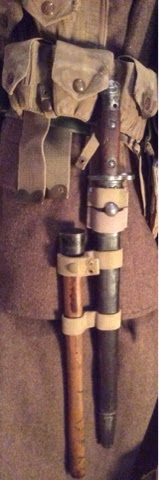
The entrenching tool handle, or helve, will eventually be joined to the frog.


Here, above and below, are proofing marks.


The next bayonet, borrowed from another friend, is the earlier Lee Metford. This appears in my Oliver Pattern photos from the 1890s. The scabbard is like a shorter version of the Lee Enfield's. The frog has an extra loop worked into the leather for a "trenching" tool. I gather this is a particular Canadian detail.


I made careful measurements of this and created my own prototype mock-up. Then, along with photos, a package was sent to the reproduction company What Price Glory to enable them to do a reproduction. Below is my effort and the reproduction that came of it.


Here is a detail of the layering of the leather.


Another frog that I'm borrowing is shown below. It's Canadian of the 1880s as well as I can identify it with an online search ( meaning I really don't know ).  According to the pictures it takes the same bayonet as seen above.


As I've said I enjoy the unexpectedness of discovery. I was talking with a cabinetry customer of mine one day and he admitted to having an old bayonet. His family had used it for fifty years to dig up dandelions. ( Do I detect survival due to civilian use here? What else would one do with an old bayonet but use it to dig up dandelions?)

Basically, for a trade, I liberated it from the garden gnomes. Here it is amazingly unspoiled.


This is the notorious Ross bayonet which wouldn't go through a German greatcoat and which attached to the rifle which jammed in the mud of Flanders.


The hole on the back loop of the combined scabbard / frog is roughly made. I've seen such holes many times. I presume scabbards were stored hanging on nails, perhaps for quick self-defense in a surprise trench raid, or against rats,....or against dandelions. Note the same hole in the previous frog.


These details show the Ross Company stamp, and a date ( 1909 ) and "C" broad arrow on the leather of the scabbard.


Here I compare this Canadian bayonet with the British Lee Enfield. They certainly have different levels of lethality, if I can create such a word.


The backdrop to all these photos is the VERY large backpack of the previous posting,


And finally the bayonet and scabbard join the entrenching tool handle in the frog. This frog is one I made a few years ago out of old bits. I saw one of these for sale once for almost $400. These are rare because there's nothing else to do with them.